Choosing a 6-Passenger Lifted Golf Cart starts with a practical question: how will you use it?
Will it carry family members, tools, groceries, or guests across uneven ground? A lifted design adds clearance beneath the chassis. Larger all-terrain tires can handle grass, gravel, packed dirt, and modest slopes more confidently. The extra seats also reduce repeated trips. That matters on large properties, campgrounds, farms, and private communities.
Golf-cart product consultant Evan Carter offers this practical view: “A six-seater earns its value when passenger capacity, ground clearance, and daily convenience work together.” His point is useful, but it needs context. More seats add weight. Lift kits can change handling. Larger tires may increase steering effort and reduce battery range. Bigger is not always better.
A dependable 6-Passenger Lifted Golf Cart should match its battery system, braking equipment, suspension, and intended terrain. Check the frame carefully. Inspect welds, tire condition, steering response, and charging performance. A 48-volt system may suit regular passenger use, but driving distance still depends on load, hills, temperature, and battery age.
Comfort deserves attention, too. Look for supportive seats, secure handholds, useful headlights, mirrors, and a stable rear-facing seat. Small details matter.
There is one common mistake: choosing appearance before capability. Shiny wheels and tall tires look impressive, yet they cannot replace proper maintenance or sensible loading. Consider storage space, turning radius, service access, and local operating requirements. The right cart is not merely larger. It is better matched to real daily demands.
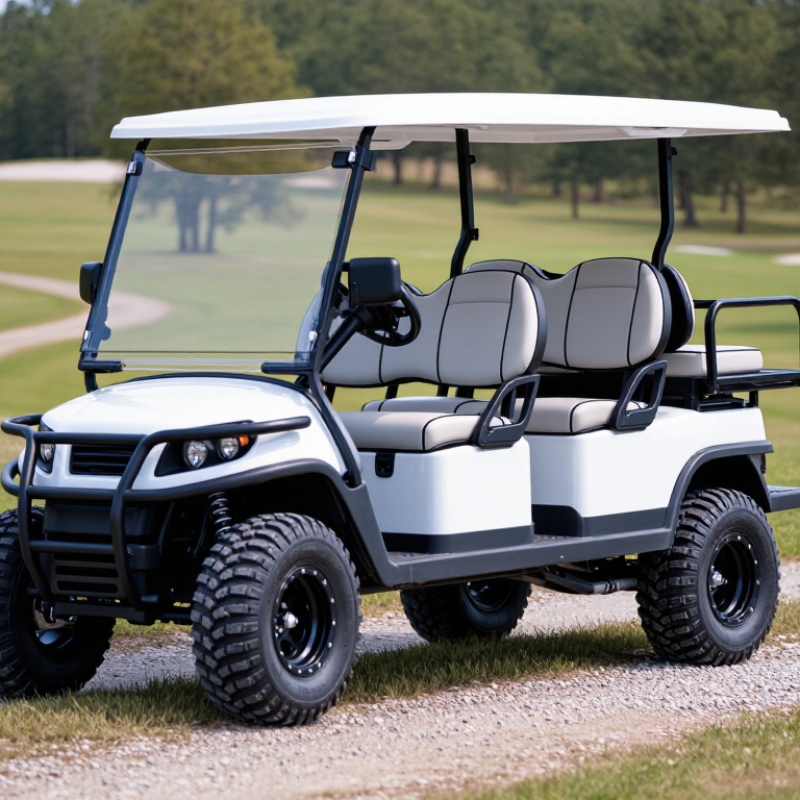
A 6-passenger lifted golf cart is a low-speed electric vehicle designed to carry six people on private roads, communities, campuses, and large properties. Its extended frame usually includes two rows of seating, with the rear passengers facing forward or backward. A lifted suspension raises the chassis and provides more ground clearance than a standard cart. Larger tires can also handle grass, gravel, and uneven paths more comfortably.
The extra seats make group travel easier. Families can move together without using multiple small vehicles. Property managers may use one cart for tours, maintenance checks, or guest transportation. The open cabin improves visibility and airflow. It also makes loading sports equipment, small tools, or groceries more convenient.
However, lifting changes the cart’s driving behavior. A higher center of gravity can reduce stability during sharp turns. Braking may feel different when six passengers are aboard. I once assumed larger tires always meant better performance, but they can increase steering effort and energy use. Check the rated passenger capacity, braking system, suspension quality, and battery condition before buying. Seat belts, working lights, mirrors, and secure handholds matter as well. The cart should match the terrain and follow local operating requirements. Six people sounds simple, but weight distribution matters. A heavy rear load can affect handling noticeably.
| Data Dimension | Typical Specification or Characteristic | Practical Meaning |
|---|---|---|
| Passenger Capacity | Up to 6 occupants | Provides seating for larger families, resort guests, work teams, or neighborhood transportation without using multiple carts. |
| Seating Layout | Two forward-facing rows or a forward-facing row with a rear-facing rear seat | The layout depends on the vehicle design. Rear-facing seats can improve passenger capacity while keeping the cart relatively compact. |
| Lifted Suspension | Commonly raised by approximately 3–6 inches (7.6–15.2 cm) | Increased ground clearance helps the cart travel over grass, gravel, uneven paths, and mild off-road surfaces. |
| Typical Overall Length | Approximately 10–13 feet (3.0–4.0 meters) | A six-passenger configuration is longer than a standard two-passenger cart, so storage space and turning clearance should be checked before purchase. |
| Typical Overall Width | Approximately 48–52 inches (122–132 cm) | The width may affect access through gates, garages, narrow paths, and storage areas. |
| Typical Ground Clearance | Approximately 7–10 inches (18–25 cm), depending on tires and suspension | Greater clearance reduces the risk of the underbody contacting small obstacles, although it does not make the vehicle suitable for severe off-road driving. |
| Powertrain Options | Electric or gasoline-powered | Electric models generally offer quieter operation and no tailpipe emissions during use. Gasoline models can be refueled quickly and may be preferred where charging access is limited. |
| Electric System | Usually a low-voltage traction system with rechargeable batteries | Actual voltage, battery chemistry, charging time, and range vary by vehicle configuration, battery age, terrain, passenger load, and weather. |
| Typical Speed | Often approximately 15–25 mph (24–40 km/h), subject to local regulations and configuration | These vehicles are designed for low-speed transportation. Operators should follow applicable road, property, and safety requirements. |
| Load Capacity | Commonly approximately 900–1,500 pounds (408–680 kg), including passengers and cargo | Six passengers, accessories, batteries, and luggage all contribute to the total load. The manufacturer’s rated capacity should never be exceeded. |
| Wheel and Tire Setup | All-terrain tires are common on lifted configurations | These tires can improve traction on grass, dirt, and gravel, but they may produce more road noise and rolling resistance than standard street tires. |
| Ride Comfort | Improved comfort is possible with upgraded springs, shocks, and seating | A lifted chassis alone does not guarantee a smoother ride. Suspension quality, tire pressure, seating, and passenger load all influence comfort. |
| Turning and Maneuverability | Generally less agile than a two-passenger cart | The longer wheelbase and added passenger weight may require more space for turning, braking, parking, and reversing. |
| Common Applications | Private communities, campgrounds, resorts, farms, large properties, and event venues | The cart is useful when passengers need to move short distances at low speed on private roads or designated paths. |
| Main Advantages | Higher passenger capacity, elevated clearance, flexible seating, and convenient short-distance transportation | It can reduce the need for multiple vehicles and provide access across a wider range of maintained surfaces than a standard low-clearance cart. |
| Important Limitations | Greater size, higher weight, increased energy use, and potentially higher maintenance costs | Buyers should evaluate storage, charging or refueling, brake performance, tire wear, suspension maintenance, and local operating rules. |
| Safety Considerations | Use seat belts where fitted, keep passengers seated, observe the rated capacity, and avoid sharp turns at excessive speed | A raised center of gravity can increase rollover risk during abrupt maneuvers or on steep slopes. Safe operation requires suitable speed and terrain awareness. |
| Best Buying Criteria | Passenger capacity, certified load rating, braking system, suspension quality, dimensions, battery or fuel requirements, and parts availability | Comparing these factors helps ensure that the vehicle matches the intended terrain, passenger load, storage space, and maintenance resources. |
Note: Specifications are typical industry ranges for six-passenger lifted golf carts. Actual dimensions, capacity, speed, range, and equipment vary by vehicle configuration, local regulations, terrain, maintenance condition, and passenger load.
It is a low-speed electric vehicle with two seating rows and raised ground clearance. It carries six people. Some rear seats face backward.
It suits private roads, campuses, farms, resorts, and large properties. It can move families, guests, tools, groceries, or sports equipment. Check local access rules before using shared paths.
The raised chassis helps pass over gravel, roots, shallow ruts, and worn pathway edges. It also reduces underbody scraping when passengers add weight. Useful on rural properties.
No. A higher center of gravity can increase body roll during sharp turns. Side slopes require extra caution. Height is not stability.
Passenger position, tire pressure, axle alignment, braking, and road surfaces all matter. A heavy rear load may noticeably change steering and braking. Keep heavier passengers near the center when possible.
Six adults, luggage, hills, soft ground, cold weather, and fast driving can reduce range. Larger tires may also increase energy use. It may feel underpowered.
Check the rated capacity, brakes, steering, suspension, tires, lights, mirrors, and battery condition. Test braking on a dry, level surface. Inspect carefully.
The cart may need more parking space and wider turning areas. Larger tires can increase noise, rolling resistance, and replacement costs. Rear-facing seats may make conversation awkward.
Measure the storage area before purchase. Consider step height for children and older passengers. A rain cover protects seats, but it solves only part of storage.
A 6-Passenger Lifted Golf Cart is a spacious electric vehicle designed to carry larger groups comfortably across neighborhoods, resorts, farms, campgrounds, and private properties. Its raised suspension and increased ground clearance help it handle uneven paths, grass, gravel, and mild slopes more confidently than a standard-height cart. The lifted design can also improve visibility and provide a more stable, comfortable ride when paired with suitable tires and suspension components.
When choosing one, consider seating layout, motor performance, battery range, charging time, braking ability, weather protection, storage space, and overall dimensions. These features make it practical for family transportation, group outings, and short-distance travel. However, its larger size may require more parking space and careful maneuvering, while lifted components can affect handling, energy use, and maintenance needs. Buyers should also evaluate local usage requirements, operating conditions, replacement costs, and long-term ownership responsibilities before making a decision.