A Custom Electric Golf Cart can look simple on a showroom floor. The right choice depends on where it will run, who will use it, and how it will be charged and serviced. Broader electric-vehicle trends offer useful context, but they are not golf-cart forecasts. The International Energy Agency’s Global EV Outlook 2024 reported nearly 14 million electric cars sold worldwide in 2023, about 18% of new car sales. That signals growing familiarity with electric transport, not proof that every region has the same charging access or buyer priorities. Details matter.
Golf use also varies by setting. The National Golf Foundation’s 2024 participation report counted 26.6 million U.S. on-course golfers in 2023, illustrating the scale of one important market. It does not measure global cart demand. A resort, a private course, and a large property may need very different seating, range, tires, and storage. Fit comes first. Buyers should compare battery chemistry, usable range under real loads, charger compatibility, local service support, customization options, and the supplier’s written warranty. A polished specification sheet can still leave practical questions unanswered. Ask how hills, passengers, weather, and accessory weight affect range; request clear documentation before ordering. These seven buying tips help global buyers assess trade-offs, check claims against their operating needs, and avoid paying for features they may never use.
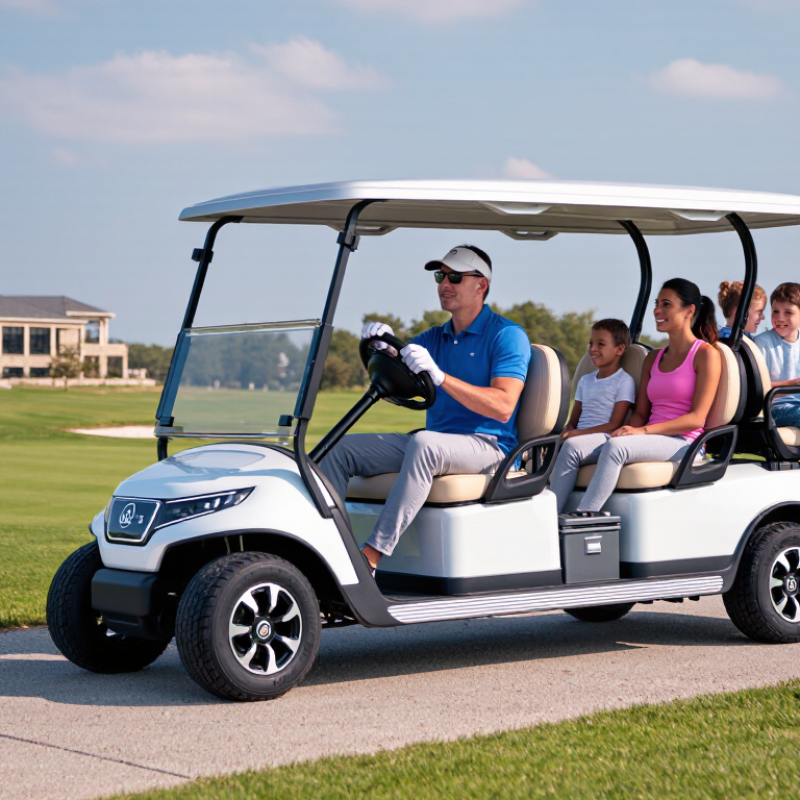
Start with real trips. Is the cart moving golfers between holes, carrying guests across a resort, or hauling tools on a worksite? The National Golf Foundation’s 2024 participation report counted 26.6 million U.S. on-course golfers in 2023, and 45 million participants when off-course formats were included. Those figures describe participation, not cart demand. Still, they show why “golf use” can mean very different routes and duty cycles. Write down typical trip length, daily trips, passenger count, and cargo before comparing configurations.
Terrain changes everything. A flat paved path, a wet slope, and a rutted service lane place different demands on tires, clearance, suspension, and braking. Ask suppliers for rated grade capability and test the cart on your actual route, with its expected load. Count adults, children, bags, tools, and fitted accessories; a six-seat layout may leave little room for cargo. Then check the range under full passenger load, not just an unloaded showroom figure. Small detail, big difference. Capacity is not only about seats: heavier loads can affect handling and battery use. I would also leave a margin for peak days, though buyers often underestimate how much space luggage takes.
Before ordering a custom electric golf cart, check how your destination classifies it. A vehicle allowed on private courses may not be permitted on public roads. Local rules can set limits for speed, passenger numbers, lighting, mirrors, seat belts, and registration. Rules differ. Ask the transport authority or a qualified local importer to confirm requirements for your exact configuration.
Safety requirements may also vary by intended use. Request test reports, component specifications, and clear instructions for charging and maintenance. Check that the charger matches the local voltage and plug type. For lithium batteries, confirm the required transport documents and packaging with your freight provider. Paperwork matters. Do not assume that a certificate accepted in one market will satisfy another market’s standards.
Import checks deserve attention before production begins. Confirm the likely customs classification, duties, taxes, and documents needed for clearance, such as a commercial invoice and packing list. Requirements can change, and classification depends on the cart’s features. Ask a customs broker to review the paperwork before shipment. A missing battery document or unclear vehicle description can hold up delivery. Easy to miss. Keep written confirmation of key requirements, even when a supplier says the cart is ready for export.
Under U.S. federal definitions, a low-speed vehicle must be capable of traveling more than 20 mph and no more than 25 mph on a paved, level surface, and have a gross vehicle weight rating below 3,000 lb. A golf cart does not automatically qualify as a low-speed vehicle. Check local road-use rules, required safety equipment, and import requirements before buying; rules vary by location.
Reference: U.S. regulations, 49 CFR § 571.3 and § 571.500.
Battery choice shapes weight, usable range, and daily charging routines. Lead-acid packs often cost less upfront, but they are heavier and need consistent charging and maintenance. Lithium packs usually weigh less and offer more usable capacity, though the purchase price is higher. Neither chemistry guarantees a specific range. Hills, passenger load, tire pressure, and cold mornings can all reduce distance between charges. Check the battery’s usable kilowatt-hours, not just its voltage. Small detail. It matters.
Charging time depends on pack capacity, charger output, and how depleted the battery is. Ask suppliers for a full-charge estimate using the exact battery and charger combination. The U.S. Department of Energy’s Alternative Fuels Data Center reports that road electric vehicles convert over 77% of grid electricity into power at the wheels. That figure is not a golf-cart test, but it shows why drivetrain efficiency deserves attention. Compare DC and AC powertrains by checking hill-climbing performance, speed control, and service requirements. AC systems can offer precise control, but configuration matters. A common buying mistake is choosing peak motor power without checking controller limits or loaded performance. Request a test run with realistic passengers and cargo. A flat showroom floor tells you little.
A custom electric golf cart should fit its daily routes, not just look impressive in a showroom. Measure narrow gates, storage areas, and turning spaces before choosing its width or seating layout. Think about passengers, too. A stable step, reachable grab handle, and clear floor space can make boarding easier for older riders or anyone with limited mobility. If a ramp or adapted controls are needed, ask for drawings and measurements before approving the order.
Materials deserve attention in the places people touch and the parts exposed to weather. Aluminum can reduce weight, while coated steel may suit buyers who prioritize a sturdy frame; ask how surfaces are protected against moisture and salt air. For hot regions, a light-colored roof and easy-clean upholstery may be more useful than decorative trim. Small detail, big difference. Still, a durable finish does not mean maintenance-free, and I would avoid assuming otherwise.
Choose features around actual use: enclosed storage for tools, a windshield for dusty paths, or extra seating for regular group trips. Accessibility options should be checked in person when possible, since step height and handle placement feel different than they look on a specification sheet. Global buyers should also confirm that replacement tires, brake parts, and electrical support are available in their destination market. It is easy to overbuild a cart; I would reconsider any feature that adds complexity without solving a regular problem.
A custom electric golf cart is only as dependable as the supplier behind its build. Request a dated configuration sheet listing motor rating, battery chemistry and capacity, controller, charger voltage, tire size, and accessories. Small details matter. Ask for serial-number traceability and pre-shipment photos of the finished cart. Compare warranty terms line by line: the frame, motor, controller, charger, and battery may have different coverage periods and exclusions. Get the warranty start date, labor coverage, freight responsibility, and claim response time in writing. A long headline warranty can still leave costly gaps.
Shipping deserves equal scrutiny. UNCTAD’s Review of Maritime Transport 2024 reports that over 80% of world trade by volume moves by sea, making port handling and paperwork important delivery risks. Request crate dimensions, gross weight, loading photos, estimated sailing time, and a clear Incoterms quote. Confirm who handles customs documents, destination charges, damage claims, and battery transport paperwork. Vague answers are a warning. Ask for a local-service plan covering diagnostics, spare parts, support hours, and a named contact. Test that process before paying the balance. It may feel excessive. But one unavailable controller can stop a cart and cost more than a modest price difference. Keep promises in the purchase contract, not only in chat messages.
| Buying Tip | What to Evaluate | Questions and Evidence to Request | Practical Buyer Action |
|---|---|---|---|
| 1. Verify supplier capability | Production experience, quality-control procedures, customization capacity, and ability to support export orders. | Request a live factory or production-line tour, product specifications, sample inspection records, and references from comparable export markets. | Confirm that the quoted supplier is the manufacturer or clearly identify any trading or subcontracting arrangements. Match the supplier’s legal details across the quotation, contract, and payment instructions. |
| 2. Define the custom specification | Passenger capacity, dimensions, motor and controller configuration, battery chemistry and capacity, seating, tires, accessories, and finish. | Ask for a written configuration sheet, drawings where relevant, rated payload, charging requirements, and a list of included and optional components. | Attach the final specification to the purchase contract. Clarify how substitutions or design changes must be approved before production. |
| 3. Check local rules and charging compatibility | Vehicle classification, road-use requirements, lighting and safety equipment, electrical supply, charger plug, and battery transport rules. | Ask which technical documents are available for the exact configuration. Check requirements with the relevant local authority, importer, or compliance adviser before ordering. | Do not assume that a golf cart is automatically approved for public-road use. Confirm local registration, equipment, voltage, frequency, and plug requirements in writing. |
| 4. Compare warranty coverage carefully | Coverage by component, warranty start date, time or usage limits, exclusions, labor, freight, and claim procedures. | Request the full written warranty. Ask separately about the battery, motor, controller, charger, and frame, and whether replacement parts or repair costs are covered. | Compare the actual terms rather than headline warranty length. Record who pays diagnostic, shipping, import, and labor costs for a claim in your destination country. |
| 5. Calculate landed shipping costs | Packaging, loading, freight mode, insurance, destination charges, customs duties, taxes, and final delivery arrangements. | Request a shipment quote that identifies the named port or delivery point, included charges, estimated transit time, packaging method, and cargo-insurance terms. | Compare quotations on the same delivery basis. Confirm who acts as importer of record and budget for customs clearance, duties, taxes, and possible port or storage fees. |
| 6. Plan inspection and payment milestones | Pre-shipment inspection, production updates, acceptance criteria, payment schedule, and documentation needed before dispatch. | Ask for dated production photos or video, a completed inspection checklist, serial-number records, and copies of the commercial invoice, packing list, and transport documents. | Agree on measurable acceptance criteria and inspection timing in the contract. Use documented payment milestones and verify any bank-detail change independently. |
| 7. Confirm after-sales and spare-parts support | Technical response process, troubleshooting materials, parts availability, service training, and support across time zones. | Ask for a spare-parts list with part numbers, parts ordering process, diagnostic instructions, expected response channel, and procedures for handling defects or transit damage. | Identify a local service partner or trained technician before delivery. Keep a record of the agreed support contacts, parts lead times, and escalation process. |
Define its daily job, typical trip length, passenger count, and cargo. A cart carrying golfers may need different features than one hauling tools.
Wet slopes, paved paths, and rutted lanes place different demands on tires, clearance, suspension, and brakes. Test the cart on your actual route with its expected load.
Count passengers, bags, tools, and accessories. Check range with a full passenger load, since showroom figures may reflect an unloaded cart. Small detail, big difference.
Measure gates, storage areas, and turning spaces before choosing the cart’s width or seating. Enclosed storage, a windshield, or extra seats can help when they solve regular needs.
Try the step height, grab-handle position, and floor space in person. Ask for drawings and measurements if you need a ramp or adapted controls.
Ask how metal surfaces resist moisture and salt air. A light roof and easy-clean upholstery may matter more than decorative trim. Durable does not mean maintenance-free.
Request a dated build sheet with battery capacity, motor rating, charger voltage, tires, and accessories. Confirm coverage periods, exclusions, labor, freight, and claim response times. I might be overcautious, but verbal promises can be hard to rely on.
Get crate dimensions, gross weight, loading photos, sailing estimates, and a clear shipping quote. Confirm paperwork, destination charges, damage claims, spare parts, local service, and a named support contact. Test that support process before paying the balance.
Buying a Custom Electric Golf Cart for international use starts with understanding how and where it will be driven. Consider its main purpose, the terrain it must handle, and the number of passengers it needs to carry. Before choosing a configuration, check the requirements that apply in the destination market, including vehicle safety standards, road-use rules, and import documentation. Compare battery types, expected driving range, charging time, and powertrain options to find a setup suited to local conditions and daily use.
Next, select practical features, durable materials, and accessibility options that fit the intended passengers and environment. Assess potential suppliers by reviewing build quality, communication, warranty coverage, shipping arrangements, and the availability of after-sales support. A clear understanding of these factors can help buyers make a more informed purchase, avoid mismatched specifications, and choose a cart that is practical to maintain and comfortable to use over time.